EUROPARC Webinar
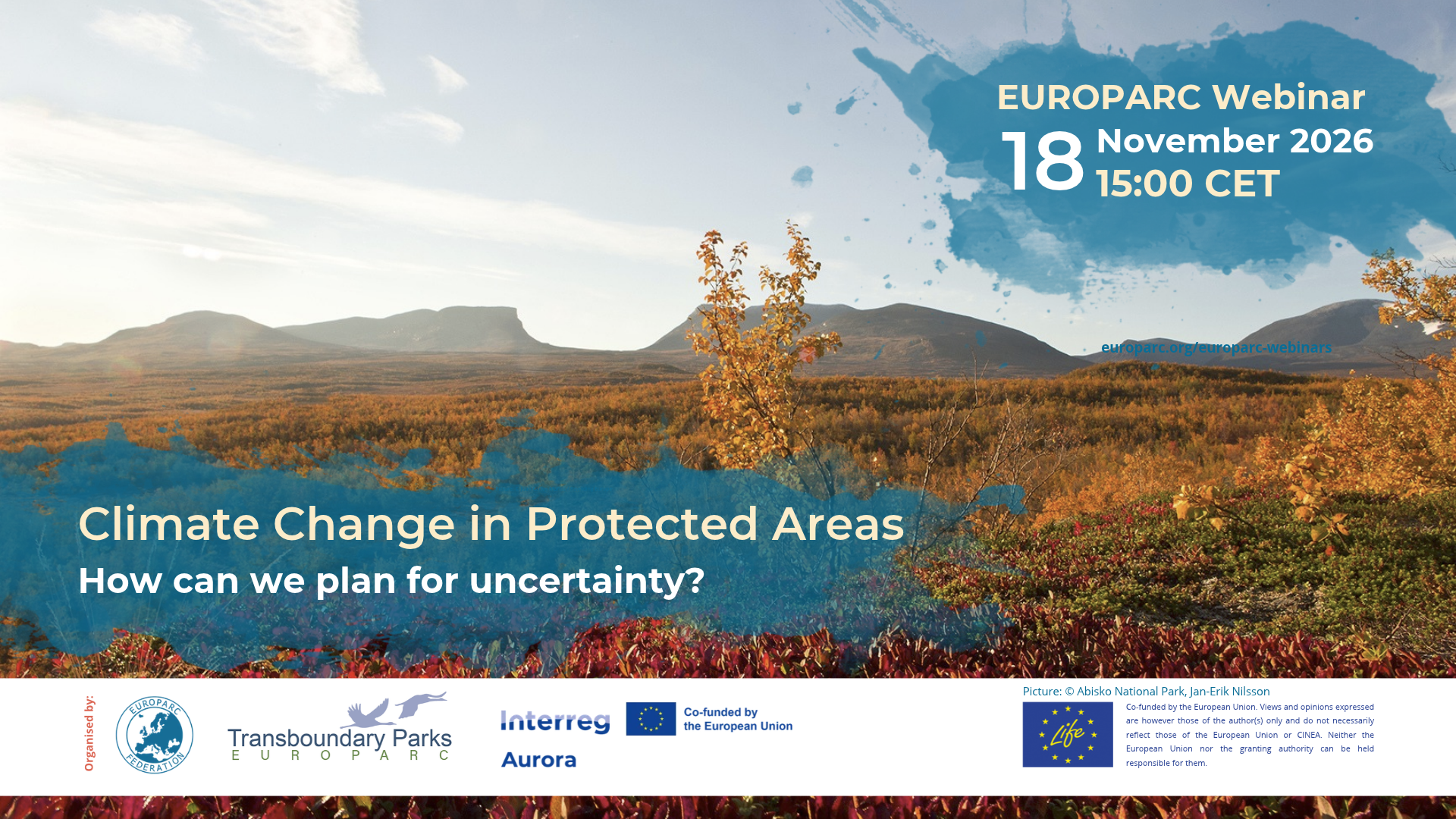
Climate Change in Protected Areas
How can we plan for uncertainty?
18 November 2026
15:00 - 16:15 CET
Climate change is reshaping the environments we seek to protect, creating new challenges for Protected Area managers. How can those working on the ground make informed decisions and plan for the future when environmental conditions are changing and the future remains uncertain?
In this webinar, we will explore how Protected Area managers can prepare for climate change through collaborative approaches, scenario-based planning, and practical adaptation tools. Furthermore, it will provide an exclusive insight into the current EU policy context related to climate change relevant for Protected Areas, with particular attention to the recently published Natura 2000 Guidance on Climate Change Adaptation
Drawing on experiences from the EU-funded CLAP project (Climate Change Communication and Adaptation of Arctic Protected Areas), the webinar will share lessons from nearly three years of cross-border collaboration between Protected Area management organizations in northern Norway, Sweden, and Finland.
Furthermore, we are joined by colleagues from the US National Park Service. Participants will explore how scenario planning, climate projections, vulnerability assessments, and the Resist-Accept-Direct (RAD) framework can help park managers identify practical adaptation strategies and prepare for future challenges.
Join us for an opportunity to exchange knowledge, explore practical approaches, and reflect on how we can better prepare Protected Areas for a changing future.
Register here:
*Your personal data is safe with us! All information provided in this form will be exclusively used by the EUROPARC Federation and it will not be shared with third parties. With your permission, we will include your email address in our contact list (which you can unsubscribe at any time) so you can always be up-to-date with our training opportunities and events, and receive useful resources for Protected Areas directly in your inbox. Want to know more? Read EUROPARC's Privacy Policy.
Programme
Welcome and Introduction
Esther Bossink & Fernando Pinillos, EUROPARC Federation
Climate Change & Protected Areas - the policy context
Frank Vassen, Team Leader Nature Conservation Unit, DG Environment
Scenario-based Adaptation in the U.S. National Park Service
Dr. Wylie Carr, Climate Adaptation Specialist, U.S. National Park Service
Climate Change in Protected Areas – lessons learned from Nordic collaboration
Anna Berhan, Nature Communication Specialist, County Administrative Board of Norrbotten, Sweden
Q&A
Participants will be able to pose questions after each of the speakers.
EUROPARC events give you the opportunity to get new ideas, tools and inspiration from other protected area professionals. At real time. Person to person. Without leaving your home.
Meet the speakers
Frank Vassen
Team Leader Nature Conservation Unit, DG Environment
Frank Vassen is a Belgian biologist and nature-conservation specialist who has worked at the European Commission’s Directorate-General for Environment (DG ENV) since 2003, initially in the LIFE programme and since 2011 in the Nature Conservation unit, where he currently works as a Team Leader. His responsibilities include the EU Birds and Habitats Directives, the Natura 2000 network, EU Biodiversity strategy targets for Protected Areas, biodiversity financing and related policies.
Climate Change & Protected Areas - the policy context
Frank will provide an overview of the current policy context related to climate change relevant for Protected Areas. In particular, he will introduce the recently published Natura 2000 Guidance on Climate Change Adaptation, and how this can support nature managers.

Anna Berhan
Nature Communication Specialist, County Administrative Board of Norrbotten, Sweden
Anna Berhan is a Nature Communication Specialist at the County Administrative Board of Norrbotten, with extensive experience in protected area management across northern Sweden. As Project Manager for the EU-funded CLAP project, she advances climate adaptation in protected areas through cross-border collaboration, capacity building, and knowledge exchange.
Climate Change in Protected Areas – lessons learned from Nordic collaboration
This presentation shares experiences from the EU-funded project CLAP (Climate Change Communication and Adaptation of Arctic Protected Areas), where managing organizations in northern Norway, Sweden, and Finland have collaborated to build capacity in climate-integrated planning, manager training, and visitor communication. Key lessons from nearly three years of cross-border work including five protected areas will be presented, offering insights on managing uncertainty and fostering adaptation in protected areas.

Dr. Wylie Carr
Climate Adaptation Specialist, U.S. National Park Service
Dr. Wylie Carr is a climate adaptation specialist with the U.S. National Park Service, where he leads efforts to develop climate adaptation guidance, training, and planning resources for parks across the United States. An environmental social scientist by training, his work focuses on helping managers prepare for changing environmental conditions through scenario planning, collaborative decision-making, and applied climate science. Before joining the National Park Service, he served as a social scientist with the U.S. Fish and Wildlife Service and U.S. Geological Survey. He holds degrees from the University of Virginia and the University of Montana.
Scenario-based Adaptation in the U.S. National Park Service
This presentation examines the U.S. National Park Service's (NPS) use of scenario-based adaptation planning, a process that considers multiple plausible futures to support robust decision-making under uncertainty. Participants will learn about how the NPS has used scenario planning across dozens of national parks, alongside complimentary tools like downscaled climate projections, vulnerability assessments, and the resist-accept-direct (RAD) framework to identify practical adaptation actions and prepare for future challenges.

Fernando Pinillos
Senior Programme Officer
Fernando has a background in marine conservation and communications. At EUROPARC, his work is focused in supporting the development of European projects, coordinating activities related with Marine Protected Areas, and overseeing the Transboundary Parks Programme.
EUROPARC’s work on Climate Change Adaptation & Transboundary Protected Areas
Fernando will provide an overview of EUROPARC’s activities related to Climate Change Adaptation in Protected Areas, as well as our Transboundary Parks Programme.
Moderator

Esther Bossink
Communications and Operations Manager at EUROPARC Federation
Organised and funded by:

Frequently Asked Questions
Who can attend the webinars?
Our webinars are targeted at Protected Area professionals and anyone interested in the topic. They are a platform for technical discussions, where experts and professionals can share their own experiences with the wider community.
Are the webinars recorded?
Yes, all EUROPARC webinars are recorded and can be found on our website under Training and Events, as well as on our YouTube channel @EUROPARC. Once you have registered, you will receive an email notification for when the recording is published for viewing.
What is the EUROPARC Federation?
The EUROPARC Federation is Europe’s largest network of Protected Area professionals. Established out of curiosity and a shared desire to learn from one another, we have been connecting people and Parks for over 50 years. Through our projects, events, and flagship programmes, we foster collaboration among experts across Europe, helping them enhance their work in nature conservation and sustainable management. Explore our infographics below to learn more about our programmes, or visit our website at www.europarc.org and see how you can get involved!
What is the Transboundary Parks Programme?
The Transboundary Parks Programme is a EUROPARC-led Programme that supports cooperation between Transboundary Protected Areas. Since its inception in 2003, the programme has set the gold standard for transboundary cooperation through its Basic Standards for Transboundary Cooperation, launched at the 5th World Park Congress. These standards, combined with an innovative verification and certification process, empower Protected Areas to achieve excellence in cross-border management.
Get all the information on the EUROPARC website here.